
Free to Serve

When we think of the word “freedom”, we often think of autonomy; basically the freedom to do whatever we want without constraint.  When the New Testament speaks about freedom, it relates to our new opportunity and ability to be all that God created and redeemed us to be.  Free to serve, free to love, free to worship, and free to embrace and live out all that became new at our new birth.

In the book of Galatians, the apostle Paul addresses the freedom challenge.  Rule-makers had infiltrated the church seeking to limit the believers’ freedom.  “But it was because of the false believers who had sneaked in to spy out our freedom which we have in Christ Jesus, in order to bring us into slavery.  But we did not yield in subjection to them for even an hour, so that the truth of the gospel might remain with you” (Gal 2:4-5).

The “truth of the gospel” Paul is referring to is our freedom in Christ.  And Paul later identifies these “false believers” as the Judaizers; a group who have come from the Jerusalem church and stressed the need for the new Gentile believers to keep the Law, including the act of circumcision.  The Law still carried some weight in their eyes both for full acceptance by God as well as a guide for living the Christian life.  Paul sees this form of legalism as so far from the truth that he did not listen to them “for even one hour.”

Paul then goes on to write a treatise on our freedom in Christ.  Paul concludes his defense with, “It was for freedom that Christ set us free; therefore keep standing firm and do not be subject again to a yoke of slavery” (Gal 5:1).  So what does standing firm in our freedom look like?

First, it is defending our freedom along the lines of the argument Paul lays out in his letter.  But it is also putting that freedom into action.  As Paul continues in chapter 5, he addresses the application part of our freedom with, “For you were called to freedom, brethren; only do not turn your freedom into an opportunity for the flesh, but through love serve one another” (Gal 5:13).

The purpose of our freedom is not to indulge the flesh – a danger Paul recognizes and spends the rest of chapter 5 exploring.  (As an aside, we have spent several posts in the past explaining the relationship between defeating the flesh and walking in the Spirit in light of Galatians chapter 5.  See here and here.)  No, the purpose of our freedom is to live into all that God redeemed us to be.  Particular to verse 13, it is the freedom to serve – motivated by love – our brothers and sisters in Christ.  In other words, use your freedom to serve each other; motivated and empowered by love.

Let your freedom from selfishness, freedom from anger, freedom from bitterness, freedom from envy, freedom from always having to win, freedom from always having to have the last word…set you free to serve one another.  It is a freedom from what is essentially our last enemy: ourselves and our selfish ambition.  And it only comes through Jesus Christ.  May you walk in that freedom today.
Sin, Slavery, and True Freedom

“So Jesus was saying to those Jews who had believed Him, ‘If you continue in My word, then you are truly disciples of Mine; and you will know the truth, and the truth will make you free‘ ” (Jn 8:31-32).  What “truth” is Jesus talking about?  And what kind of “freedom” does this truth deliver to us?

The dialogue that immediately follows these verses gives a clue to the freedom offered by Jesus Christ.  The Jews parked on the word “free” and answered Jesus.  “We are Abraham’s descendants and have never been enslaved to anyone; how is it that You say, ‘You will become free?’ ” (Jn 8:33).  The Jews were thinking in terms of political freedom; that is, in specific terms of slaves and masters.  Basically they were saying, “How can you offer us freedom when we are already a free people?”

Now it is ironic that the Jews would strut their freedom at a time they are under Roman rule, but technically they are correct.  Slavery was common throughout the Roman Empire, and the Jews were not slaves in the specific sense of owned by masters.  They had a measure of political freedom.

But Jesus is not talking about political freedom as we continue in the passage.  “Jesus answered them, ‘Truly, truly, I say to you, everyone who commits sin is a slave to sin’ ” (Jn 8:34).  The freedom Christ promises and delivers is the freedom from slavery to sin.  This language is a forerunner to the exact same word picture used by the apostle Paul in Romans chapter 6 regarding sin, slavery, and true freedom.

“Knowing this, that our old self was crucified with Him, that our body of sin might be done away with, that we should no longer be slaves to sin; for he who has died is freed from sin” (Rom 6:6-7).  Based on the context, “freed from sin” means freed from sin’s power and control, not from sin’s presence.  And Paul sums up this idea with, “For sin shall not be master over you” (Rom 6:14).

Not only is sin no longer our master, but God has given us the power to choose a new master, Jesus Christ.  “Do you not know that when you present yourselves to someone as slaves for obedience, you are slaves of the one whom you obey, either of sin resulting in death, or of obedience resulting in righteousness?  But thanks be to God that though you were slaves of sin, you became obedient from the heart to that form of teaching to which you were committed, and having been freed from sin, you became slaves of righteousness” (Rom 6:16-18).  Notice the time line: you were slaves of sin, you became slaves of righteousness.

Returning to our text in John chapter 8, Jesus concludes, “So if the Son makes you free [free from sin’s power and mastery], you will be free indeed” (Jn 8:36).  The freedom Jesus promised in John 8:32 – the oft quoted, “You will know the truth, and the truth will make you free” – is the freedom from sin’s slave-creating power; freedom from sin as our master.  It is a promise of freedom that should be the hallmark of our gospel message.

We are keen on explaining the gospel message in terms of our deliverance from sin’s penalty as we should be.  But let us never forget the equal part of the gospel, deliverance from sin’s power.  The promise of a heart set free from sin’s power – so eloquently argued by the apostle Paul in Romans chapters 5 through 8 – has its foundation in Jesus proclamation, “You will know the truth, and the truth will make you free.”

Breaking Free

If you were to take a poll of your friends and relatives, what phrase would they most associate with the word “Christian”?  Would it be keeping the rules…religious…being a good person…hypocrite…or something else?  Getting it down to one phrase, I think something about “keeping the rules” is one of the world’s most common associations with Christianity.

But if you read the New Testament, where we find our Christian faith explained, I think a better word association is “FREEDOM”.  Christianity is all about freedom.  The powerful connection between Christianity and freedom – so clearly explained in Scripture – is often missed by a world under the enemy’s control and a church stuck in our rule-making ways.  Why is this so?

From the world’s viewpoint, they have no interest in accurately portraying one of the greatest aspects of our Christian belief.  The Bible teaches that the world system lies in the grip of the evil one and as such it is in the world’s interest to paint Christianity in the most negative light possible.  The world will always present Christianity as burdensome, narrow-minded, foolish, misguided, angry, and worse.  This is to be expected from an entity that literally hates us.  “If the world hates you, you know that it has hated Me before it hated you.  If you were of the world, the world would love its own; but because you are not of the world, but I have chosen you out of the world, because of this the world hates you” (Jn 15:18-19).

So it is easy to see the world’s motivation for ignoring the freedom message of Christianity.  But what about the church?  Why do we not highlight the compelling message of freedom found in the New Testament;  freedom in Christ, freedom from the power of sin, freedom from the penalty of sin, freedom from besetting sins and habits, freedom from the Law, freedom to love, freedom from status needs, freedom from condemnation, freedom from our own selfishness?  Is the freedom promised in the New Covenant a staple of the preaching in your church environment?

I think many times we present a distorted message that actually undermines the freedom promised in the New Testament.  We try to squeeze Christianity into an Old Testament framework and come out with a burdensome form of legalism.  We struggle to accept that believers – ourselves included – are truly good people, being infused with God’s righteous nature.  We think freedom unchecked will lead to increased sin and moral license.  We need rules to keep our fellow believers in line.  We need rules to give immature leaders a feeling of power and control.  And finally, maybe we actually enjoy a “ministry of condemnation”, Paul’s description of the old covenant.

But in Christ, we have been set free;  free from condemnation (“Therefore there is now no condemnation for those who are in Christ Jesus” Rom 8:1),  free from rule-keeping (“But now we have been set free from the Law, having died to that by which we were bound, so that we may serve in newness of the Spirit and not in oldness of the letter” Rom 7:6),  free from sin’s power (“Our old self was crucified with Him, in order that our body of sin might be done away with , so that we would no longer be slaves to sin; for he who has died is freed from sin” Rom 6:6,7).

When the New Testament speaks for itself, one of the most powerful promises of Scripture is a life set free in Christ.  This freedom is so compelling, and this freedom is so needed in our churches that we will spend the next several posts exploring its depths.

But let me close this time with a riddle to get you thinking.  If you have attended church for any length of time or have listened to Christian radio, you have probably heard this phrase from John chapter 8 quoted more than once, “You will know the truth, and the truth will make you free” (Jn 8:32).  But have you ever wondered what “free” means in this context?  Have you ever asked, “Free from what?”

Ironically, Jesus answers this exact question in the verses immediately following this common quote.  But I don’t think I have ever heard them referred to in a sermon.  Isn’t that curious?  What is the answer?  We will discuss it next time.

Finding a Balance…Wrap-up

Well, here we are at the end of our Work-Family-Ministry Balance series.  Thank you for your interest and comments.  By God’s gift, this was and is our own family identity.  These are not theories that belong in a book or ideas that we never actually got around to.  No, this was and is the fabric of our family life.

So let me close with a few reminders from our last few weeks together.

children-drawing

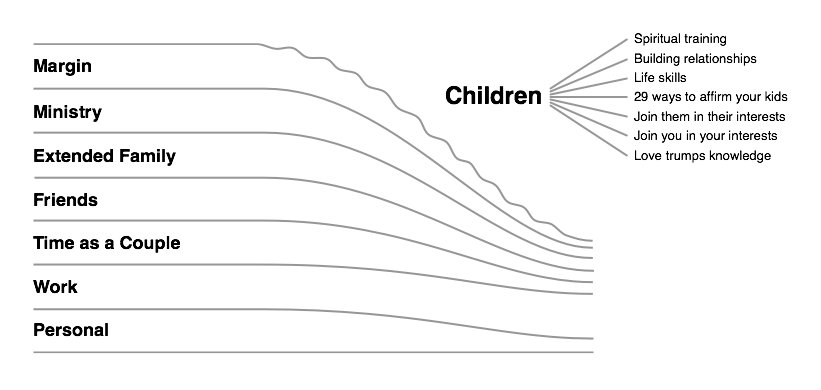
Reviewing our chart above, remember…

  • The time commitments on the left side are going to be “squeezed” when children join our family.
  • We can’t let these “squeezed” areas go to zero.
  • If our time as a couple goes to zero in these busy children years, there will be no spark, no flame, no fire, no romance when we emerge on the other side and the kids have left the house.
  • Margin is not a spiritual concept, but availability to serve and go the second mile is.
  • The upper right side of our chart is not babysitting or child care; it is investing.
  • It is investing in your child’s future and your legacy.
  • Kids spell love T-I-M-E.
  • Building the relationship is more important than rules of control.
  • Your quitting time at work is your starting time at home.
  • You may feel indispensable at work; you are indispensable at home.
  • Show your wife, by your actions, that you are in this together.

Can you do this?  Yes, you can!  How do I know that?  Because if you are a Christ follower, you have been gifted with all that became new at your new birth to be a godly husband and father.  You have your degree.  You have your papers.  You are qualified to do this.

So take the next step in your journey of leading your family, and I will see you around the water cooler, the church foyer, or the baseball field.

Perfection Is Not The Goal…Consistency Is

For the past few weeks, I have been sharing material from a presentation I give on finding a Work-Family-Ministry balance.  One of the habits I stressed in the spiritual training of our children section was reading the Bible and praying as a family.  In fact, it was so important to Rhonda and I that our goal was to do this every day.  When I make this presentation to a group, I always close with this question to make my concluding point, “You have only known me for about 45 minutes.  But based on what I have shared and hearing this talk, if our goal was to read the Bible every day as a family and this is considered 100%, what percentage do you think we actually accomplished?  If every day equals 100%, take a guess on how we did on a percentage basis.”

As you can imagine, the guesses are quite varied.  But they usually land between 75 and 95%.  I say, “You are being generous.”  When Rhonda and I look back on 30+ years of having kids in the house, we estimate that we probably read the Bible together as a family about 30-40% of the days we intended to.  Now at first glance, this may look like a failure.  It may appear that we have a pretty poor track record at reaching our goal.  But we see it as just the opposite.

Using the higher end of our range at 40%, this means that we read together 150 DAYS A YEAR MORE THAN ZERO for over 30 years.  That is a lot of Bible reading.  The point I am trying to drive home is this: PERFECTION IS NOT THE GOAL; CONSISTENCY IS.

If perfection is your goal, you will drive your kids, your wife, and yourself crazy.  It is unattainable.  No, perfection is not the goal.  The goal is consistency.  This is about real life.  This is about chronic illness, recalcitrant children, financial setbacks, nagging sins, work stresses, personality challenges, fickle friendships, and academic hardships.  Consistency is getting back on the horse when we have been knocked down by these life issues.  Consistency is about not giving up no matter how long it has been since we tasted success.

Using the example we have been talking about, sometimes we would not read together for a month or more.  In these times, I would always think the same thing.  The kids are not even asking about our Bible reading.  No one even seems to miss it.  Maybe it is not having the influence or consequence that I think it is for our children.  Let’s just quit and let the Bible reading habit go.  But fortunately, I am married to a consistent wife who was not interested in letting any good thing go.  Rhonda encouraged me over and over that we can do this.  We just need to pick up the Bible and start again.

It was not just the Bible reading.  Every valuable discipline that we ever had in our home was on again, off again.  And Satan sought to use the “off again” as a temptation to quit.  Did you hear that?  Satan seeks to use the “off again” as a temptation to quit.  But God would always give us the quiet reminder and the strength to pick up the ball and get back in the game of investing in our family.  And soon, we were back to “on again”.  Let me emphasize again, perfection is not the goal; consistency is.

May I encourage you that no matter where you are along the time line with your family, it is never too late to start or begin again to read the Bible together as a family, to develop a relationship with your children, to affirm your children, to make your quitting time at work as important as your starting time, to value your time as a couple, to preserve some margin in your family life for service, and to let love rule.  As my friend Dave Gibson says, “It is never too late to start and always too soon to quit.”