
Advent Day 17: The King We Didn’t See Coming

This framework of how Jesus did and did not fit the expectations of His first-century audience and how Jesus, the secret king, set up His secret kingdom brings so much depth to our own understanding of Jesus’ words, actions, and events of the Gospels.  And it explains the reaction to Him that sometimes puzzles us.  The Jews tried to interpret the coming of the Messiah with a distinctively Old Testament mindset.  Of course, this makes sense to us now as this was the revelation they had.  And it was God’s revelation.

Throughout the Scriptures, God’s revelation is always true, but not always complete.  We cringe at the idea of God’s revelation being progressive.  We don’t want to hear anything that may alter our understanding of our eternal God; the same yesterday, today, and forever.  Please understand the difference.  The character and attributes of God have never changed and will never change.  He is without beginning and without end, always the holy and unique God of creation.  There is nothing progressive about God’s character or attributes.  But His revelation is progressive.

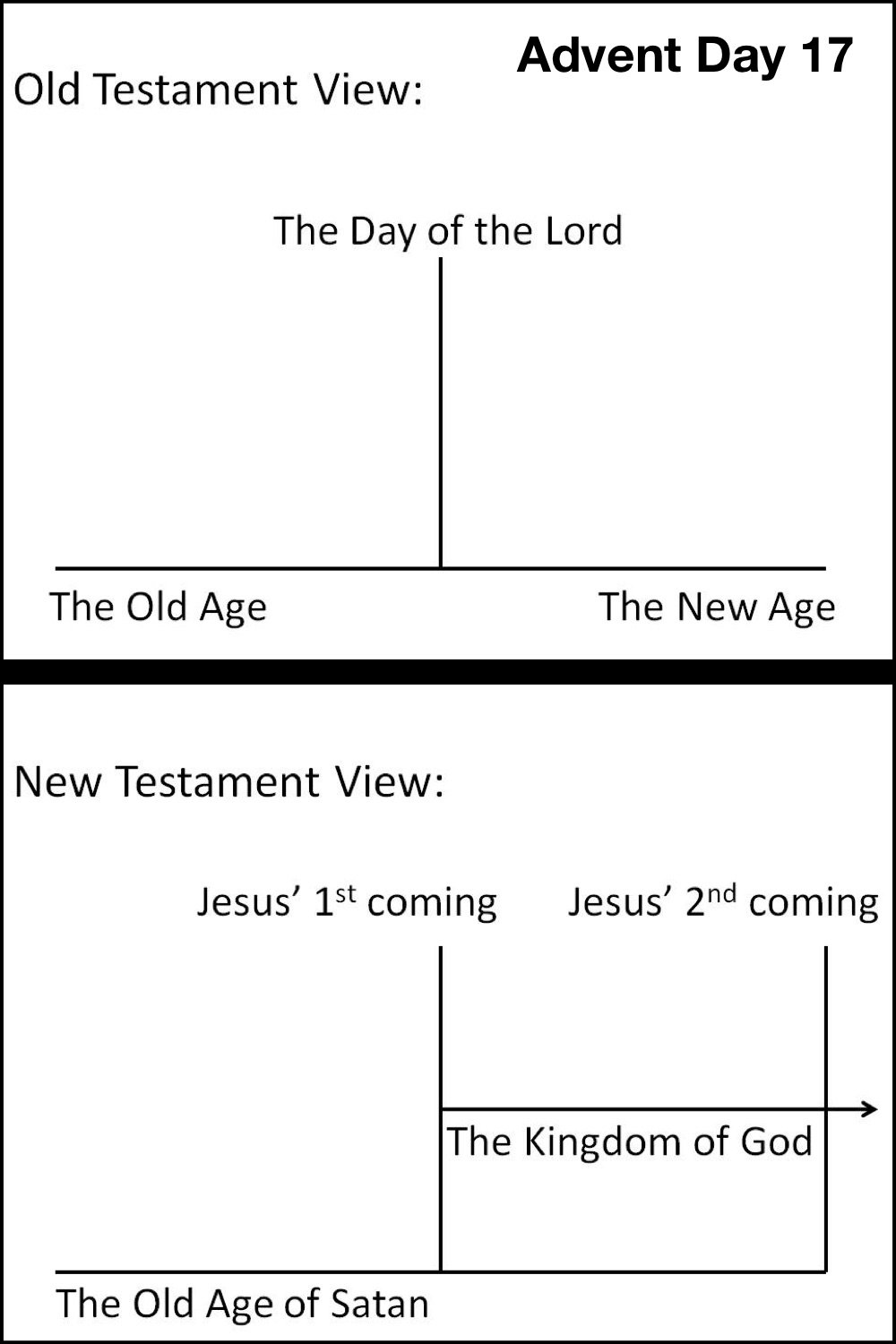
At the time of Christ, most Jews – scholars included – were totally unprepared for Who was coming and the manner in which He came.  They expected the Messiah to arrive explosively and carry out His judgment and restoration immediately.  The arrival of the Messiah would be the clear demarcation between the old age and the new age (See upper chart below).  Both a casual or detailed reading of the Old Testament fit this picture.

Given the advantage of hindsight regarding our Lord Jesus Christ and the explanation of the New Testament writers, we see that the Old Testament was actually announcing two comings.  At His first coming, Jesus came to usher in the kingdom of God through His death on a cross providing the way for us to be saved from our sins and to become citizens of God’s kingdom.  Salvation was the plan for Jesus’ first coming.  And as we learned from the parable of the wheat and the weeds, God’s kingdom and the kingdom of Satan now exist together here upon the earth (See lower chart below).  Judgment was not the goal of Jesus’ first coming which He made clear in both word and action.

Jesus’ second coming will finally usher in the Great and Awesome Day of the Lord.  And Jesus will fulfill all the Old Testament prophesies regarding vengeance, judgment, and His righteousness covering the earth.  Satan’s kingdom will be brought to an end and God’s kingdom, currently underground if you will, will become public in dramatic fashion and will continue forever.  The secret king will be worshipped by all and take His rightful place on a public throne.
Advent Day 16: The Resurrected King

The miracle of the resurrection is the cornerstone of our faith and without it we are of most men to be pitied (I Corinthians 15:19).  Its publicity, however, is the opposite of the Palm Sunday drama.  The drama of the resurrection is that it was witnessed by very few people.  It was basically a private event.  Have you ever thought about that?  We, including the Apostle Paul in I Corinthians 15, like to use eyewitness testimony to support our claim that Jesus did indeed rise from the dead, as we should.  And Jesus did make enough public appearances to provide a foundation for our faith.  But think about the numbers.  The best Paul can come up with at one time is 500?  Yes, 500.

Where are the appearances before 5000?  What about an appearance in the temple, a place where Jesus had regularly addressed the crowds just a week earlier?  Would that have been helpful?  Where are the appearances before the skeptics, the Pharisees, and the rulers?  For some reason, following His resurrection, Jesus took His kingdom almost completely underground.  Have you ever thought about that?  So many public appearances in Jesus’ former life, and then very few after His resurrection.

So to summarize the timeline of events surrounding the announcement of the coming of the kingdom, we have the following:

  • Jesus’ early ministry:  announced the arrival of the kingdom of God.
  • Jesus’ earthly ministry:  public, but downplayed the King title.
  • Palm Sunday:  public, and embraced the King title.
  • Death:  public place of execution, witnessed by many.
  • Resurrection:  private, witnessed by very few people.
  • Ascension:  Very private, by invitation only.  And poof, Jesus was gone, back to heaven.

And this is where we live today; citizens of a secret kingdom.  But secret does not mean powerless.  Remember the kingdom of God is within us.  And the same power that raised Christ from the dead infuses the citizens of His kingdom.  It really is a kingdom not of this world.  It is a kingdom that is largely invisible to this world.  At the same time, it is a kingdom of supernatural citizens whose true home is somewhere else; citizens who truly are “in the world but not of it.”

Advent Day 15: The King is Crucified

With the exception of the Last Supper and the Garden of Gethsemane, the passion week remained a public week for Jesus right up to His crucifixion.  His death was very public.  His trials bounced from leader to leader with stops before the crowds clamoring for His death.  He carried His cross through the public streets and died in a public place of execution.  His death made news throughout the entire city and beyond.

Remember the two disciples on the road to Emmaus the next Sunday who, not suspecting their guest was Jesus, said, “Are you the only one visiting Jerusalem and unaware of the things which have happened here these days … concerning Jesus the Nazarene?” (Luke 24 18-19).  Christ died a very public death.

So less than a week after Palm Sunday, the King was dead.  Now silence.  The dead King is buried.  In the world’s eyes, the very public figure, who less than a week earlier accepted the multitude’s praise as Messiah King, is dead.

But something is stirring in our minds.  What are we to make of the Isaiah 61 passage that launched Jesus’ public ministry?  Jesus said it referred to Him.  What are we to make of His claim to be God’s Son?  And what about His own prediction that He would be “delivered up to the Gentiles to mock, scourge, and crucify Him, and on the third day He would be raised up.” (Matthew 20:19)?  What are we to do with “the King is dead” but wait?

What happens next is dramatic in more ways than just the awesome miracle of the resurrection, as powerful and incredible as that was.  How dramatic?  We will talk about it next time.

Advent Day 14: The King is Announced

In the gospel of John, Jesus’ proclamation at the feast, His attesting miracles, His identifying Himself as one with the Father, and His announcement that eternal life is found only in Him are all leading to the recognition that He could indeed be the promised Messiah.  This momentum builds toward the Sunday before the Jewish Passover.  In an event we now call “Palm Sunday,” Jesus entered Jerusalem on the back of a donkey in fulfillment of the prophet Zechariah’s words from circa 500 BC.  “Now this took place (the triumphal entry into Jerusalem) that what was spoken through the prophet might be fulfilled, saying, ‘Say to the daughter of Zion, “Behold your King is coming to you, gentle, and mounted upon a donkey, even upon a colt, the foal of a beast of burden” ‘ “ (Matthew 21:4-5 quoting Zechariah 9:9).

Luke further describes the scene, “And they brought [the colt] to Jesus, and they threw their garments on the colt, and put Jesus on it.  And as He was going, they were spreading their garments in the road.  And as He was now approaching, near the descent of the Mount of Olives, the whole multitude of the disciples began to praise God joyfully with a loud voice for all the miracles they had seen, saying, ‘Blessed is the King who comes in the name of the Lord; peace in heaven and glory in the highest!’  And some of the Pharisees in the multitude said to Him, ‘Teacher, rebuke Your disciples.’  And He answered and said, ‘I tell you, if these become silent, the stones will cry out!’ “ (Luke 19:35-40).

In a complete reversal from the feeding of the five thousand when Jesus fled the multitude’s attempt to make Him king, He now embraces their praise and recognition that He is the promised king.  The crowds cry out, “Blessed is the King who comes in the name of the Lord” (Luke 19:38), ascribing this title to Jesus, the Nazarene.  In fact, this day was so ordained for Jesus’ kingdom to become public that if the crowd were silenced, as the Pharisees demanded Jesus do, the rocks themselves would cry out the proclamation.

Now we enter the tumultuous passion week of our Savior.  The week starts with Jesus staying in the public eye.  “And [Jesus] entered the temple and began to cast out those who were selling, saying to them, ‘It is written, “And My house shall be a house of prayer,” but you have made it a robber’s den.’  And He was teaching daily in the temple; but the chief priests and the scribes and the leading men among the people were trying to destroy Him, and they could not find anything that they might do, for all the people were hanging on His words.” (Luke 19:45-48).  Jesus’ cleansing of the temple and daily teaching in the temple were very public aspects of His ministry during the passion week.

Of course, a dramatic turn of events is coming as the passion week is unfolding.

Advent Day 13: Jesus at the Feast

Let’s return now to John chapter 7 and the advice of Jesus’ brothers.  You may recall their message to Jesus was, “You are doing all these miracles here in the backwater of Galilee.  If publicity is what you are after, go to the big city, Jerusalem, and put on a show there in front of the big crowds.”  Of course, publicity was not what Jesus was after and He initially passed on their suggestion.  But the time was soon ripe for the next revelation of the Messiah King.  Let’s see what happens next.

Jesus did end up going to the feast in Jerusalem shortly thereafter, and while there, announced Himself to the crowd.  “Now on the last day, the great day of the feast, Jesus stood and cried out, saying, ‘If any man is thirsty, let him come to Me and drink.  He who believes in Me, as the Scripture said, “From his innermost being shall flow rivers of living water.” ‘  But this He spoke of the Spirit, whom those who believed in Him were to receive; for the Spirit was not yet given, because Jesus was not yet glorified” (John 7:37-39).

This public proclamation of Jesus animated the crowd and they responded, “Some of the multitude therefore, when they heard these words, were saying, ‘This certainly is the Prophet.’  Others were saying, ‘This is the Christ (i.e. the Messiah).’  Still others were saying, ‘Surely the Christ is not going to come from Galilee, is He?’ “ (John 7:40-41).  Others probably returned to their question from John 6 when Jesus described Himself as the bread come down from heaven.  “They were saying, ‘Is not this Jesus, the son of Joseph, whose father and mother we know? How does He now say, “I have come down out of heaven”?’ ” (John 6:42).  Questions, assumptions, and guesses.

Something is stirring.  The crowd is quizzical.  Could it be that the promised Messiah King has finally arrived?  Could Jesus of Nazareth fit the bill?  Is Jesus about to go public with His kingdom?  All questions for next time.