
The Old Covenant

Five hundred years after the Abrahamic covenant, we come to a detour on the covenant train.  We find ourselves face to face with what is known as the old covenant.  Abraham’s descendants have gathered at the foot of Mt Sinai.  Here God initiated the old covenant, also known as the Law, through His prophet, Moses.

“Moses went up to God, and the LORD called to him from the mountain, saying, ‘Thus you shall say to the house of Jacob and tell the sons of Israel:  “You yourselves have seen what I did to the Egyptians, and how I bore you on eagles’ wings, and brought you to Myself.  Now then, if you will indeed obey My voice and keep My covenant, then you shall be My own possession among all the peoples, for all the earth is Mine; and you shall be to Me a kingdom of priests and a holy nation.”  These are the words that you shall speak to the sons of Israel.’  So Moses came and called the elders of the people, and set before them all these words which the LORD had commanded him.  All the people answered together and said, ‘All that the LORD has spoken we will do!’  And Moses brought back the words of the people to the LORD” (Exodus 19:3-8).

The rest of the Old Testament is a record of Israel’s struggle to keep their “we will do it” part of the old covenant.

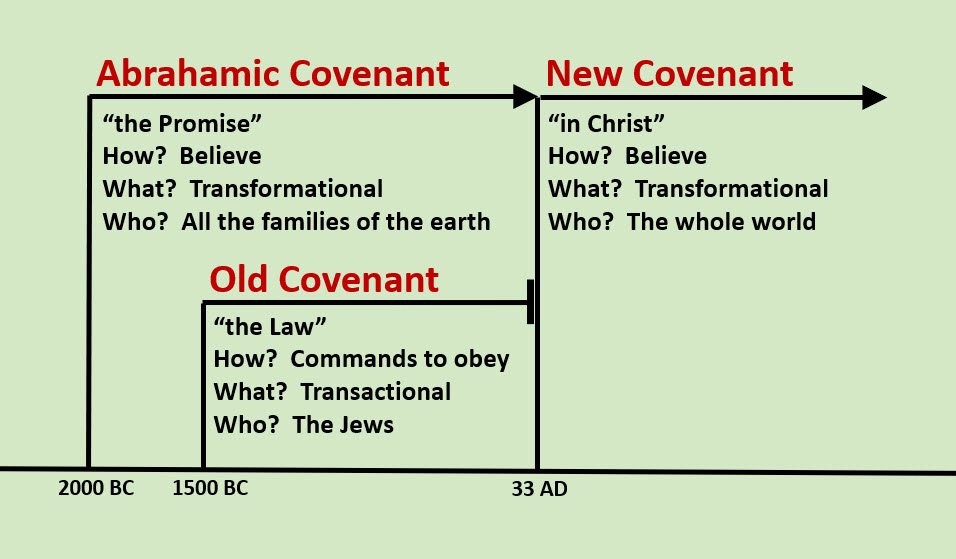
Let’s compare and contrast what we know about the Abrahamic covenant and the old covenant of the Law.  Let’s start by listing the five distinctives of the Abrahamic covenant that we covered in our first post and contrast them with their old covenant counterpart.  (AC = Abrahamic covenant, OC = old covenant)

1. AC: It was a covenant based on God’s promise, not Abraham’s action.
OC: It was a covenant based on man’s obedience.

2. AC:  It was a promise to bless all the families of the earth, both Jew and Gentile.
OC:  It was only for God’s chosen people at that time; the Jews.

3. AC:  It was a promise fulfilled in the one who “believed”, not based on religious activity or behavior.
OC:  It was a blessing given based on one’s obedience.

4. AC:  It was a covenant that was transformational, not transactional, signified by changing Abram’s name to Abraham.
OC:  It was a covenant that was purely transactional; blessing based on obedience, a curse for disobedience.

5. AC:  It was a covenant between God and God; Abraham was the beneficiary.
OC:  It was a covenant between God and man.

Next time, we will talk about where the new covenant fits into this picture.  But I will give you a hint while we are waiting.  The new covenant aligns with ALL of the Abrahamic provisions and NONE of the old covenant requirements.
God’s Covenant with Abraham

In Genesis chapter 12, God made a spectacular promise to Abram.  “I will make of you a great nation, and I will bless you and make your name great, so that you will be a blessing.  I will bless those who bless you, and him who dishonors you I will curse, and in you all the families of the earth shall be blessed” (Genesis 12:2-3).

But by Genesis chapter 15, Abram is having his doubts.  He reflects on his advanced age and no heir.  So God repeats His promise, “And behold, the word of the LORD came to Abram: ‘This man [Abram’s servant] shall not be your heir; your very own son shall be your heir.’  And He brought him outside and said, ‘Look toward heaven, and number the stars, if you are able to number them.’ Then God said to him, ‘So shall your offspring be.’  And he believed the LORD, and God counted it to him as righteousness” (Genesis 15:4-6).

Then God sealed His promise with a covenant in the remainder of Genesis chapter 15.  To summarize the next several verses, God asked Abram to gather a heifer, a goat, a ram, and some birds.  Abram cut the heifer, goat, and ram in halves and placed the halves opposite each other.  Then a deep sleep fell upon Abram.  He was out cold!  When evening arrived and the sun went down, God in the form of a smoking fire pot and flaming torch passed between the animal pieces.  God’s speech at this ceremony expanded on some specifics of His promise to Abram.

God confirmed His promise to Abram by making a covenant, sealed by passing between the animal parts, between Himself and … Himself.  The covenant ceremony was between God and God.  Abram was asleep!  Abram had no part in the ceremony.  Abram had nothing to contribute to the covenant.  But he was clearly the beneficiary of the covenant between God and God.  Sound familiar?

When God initiated the new covenant through the spilled blood of Jesus Christ, you and I were much more than asleep.  We weren’t even born.  And when we did arrive on the scene, we were worse than asleep, we were dead in our sins and trespasses.  But we – while making absolutely no contribution to it – became the beneficiaries of the new covenant brought by Jesus’ death and resurrection.  How?  By believing.

The same way Abram became the beneficiary of God’s Genesis 15 covenant (“And he believed the LORD, and God counted it to him as righteousness” vs 6) is exactly how we receive all the promise and provision of the new covenant.  “Then they said to Him, ‘What must we do, to be doing the works of God?’  Jesus answered them, ‘This is the work of God, that you believe in Him whom He has sent’ (John 6:28-29).  Simply believe!

Three Covenants

“For it is written that Abraham had two sons, one by the bondwoman [Hagar] and one by the free woman [Sarah].  But the son [Ishmael] by the bondwoman was born according to the flesh, and the son [Isaac] by the free woman through the promise.  This is allegorically speaking, for these women are two covenants” (Galatians 4:22-24).

The apostle Paul goes on to explain in Galatians chapter 4 that Sarah and Isaac are a picture of the new covenant while Hagar and Ishmael are representatives of the old covenant.  How are Sarah and Isaac connected to the new covenant when they lived almost 2000 years before the new covenant came through Jesus Christ?

We will get back to that question, but let’s start with a look at an earlier covenant; a covenant prior to both the old and the new.  Isaac is called a son of promise because his story is wrapped up in the promise of God to Abraham, a promise we refer to as the Abrahamic covenant.  This covenant, first revealed in Genesis chapter 12 and repeated in various forms throughout Abraham’s lifetime, contains these highlights:

  1. It was a covenant based on God’s promise, not Abraham’s action.
  2. It was a promise to bless all the families of the earth, both Jew and Gentile.
  3. It was a promise fulfilled in the one who “believed”, not based on religious activity or behavior.
  4. It was a covenant that was transformational, not transactional.
  5. It was a covenant between God and God; Abraham was the beneficiary.

Does all of the above sound familiar?  It certainly does!  It sounds a lot like the new covenant, ushered in by Jesus.  But before we search the riches of the connection between the Abrahamic and new covenants, let’s take a closer look at God’s covenant with Abraham.  We will start there next time.

Being Perfect

The Sermon on the Mount (Part 11 of 11)

“Therefore you are to be perfect, as your heavenly Father is perfect” (Matthew 5:48).  Jesus wraps up Matthew chapter 5 with this powerful summary statement, “Be perfect as your Father is perfect.”

Leading up to this conclusion, Jesus lays out a series of “You have heard it said … but I say to you” directives.  This is Jesus’ way of saying to the braggadocious law-keepers of His day, “You think you know the Law (‘You have heard it said’), check out what I am adding to it (‘But I say to you’).  It is a much higher calling than you know.”  And by the end of the chapter Jesus states it clearly; being right with God requires perfection.  Wow!

(As an aside, I often hear this verse preached with “perfect” being explained as “mature”.  The verse is somehow about us maturing into what God desires of us.  DON’T WATER IT DOWN.  Perfection is perfection.  And perfection is required to be right with God.)

Jesus’ hearers would have been scratching their collective heads or just ignoring His words.  They would have no idea what to do with perfect.  That goal is impossible.  How can any human be perfect in the sight of God?

Because we know the rest of the gospel story, we agree; perfection is impossible.  And if the gospel story ended right here, we would be left in that conundrum.  We would be lost in our imperfection, our sin.  But praise be to God, Someone became perfection FOR US!  Someone became the righteousness that surpasses the scribes and Pharisees FOR US!  “God made Him who knew no sin to be sin on our behalf, so that we might become the righteousness of God in Him” (II Corinthians 5:21).

And what about perfection?  Just when you think perfection is impossible, look what the author of the book of Hebrews says, “For by one offering He has perfected for all time those who are sanctified” (Hebrews 10:14).  You are sanctified, set apart and perfected, by the offering of Jesus.  He did it all!

Does that mean we are perfect in our actions and attitudes?  No, our behavior is energized by the new resurrection power of Christ living His life in us.  But it also faces headwinds from our enemies of the world, the flesh, and the devil.  But our new identity is perfect, righteous, and blameless.  “Yet He has now reconciled you in His fleshly body through death, in order to present you before Him holy and blameless and beyond reproach” (Colossians 1:22).

In Matthew 5:48, Jesus is not only laying out a requirement that the law-keepers would have found impossible to live up to.  But as with much of the Sermon on the Mount, Jesus is being prophetic in His announcement.  Something that He has not explained or even alluded to yet is that He will become our perfection.

We and Jesus both know that we can never arrive at perfect on our own.  We are only perfected by what Christ accomplished for us.  We became perfect because God made us perfect by an act of His grace.  Don’t cringe at the word “perfection”.  You did not earn it and left to yourself you cannot keep it.  We are delivered, made perfect, and kept by the beautiful grace of God.

Righteousness that Surpasses

The Sermon on the Mount (Part 10)

“For I say to you, that unless your righteousness surpasses that of the scribes and Pharisees, you shall not enter the kingdom of heaven” (Matthew 5:20).  Jesus has come to the end of His introduction to the Sermon on the Mount.  The first 19 verses of Matthew 5 introduce us to who you will become when you enter the kingdom of heaven by faith in Jesus.  Jesus is looking forward to who you will become under the new covenant arrangement when you believe in Jesus.  The promise of the new covenant is that you will become … gentle, peaceful, merciful, pure in heart, have your hunger and thirst satisfied, be persecuted for righteousness, be the salt of the earth, be the light of the world, see the Law requirements fulfilled by Jesus, and be set free from the Law.

Verse 20, quoted above, starts us into the next section of Jesus’ sermon.  Remember, Jesus began His public ministry with this message, “Repent and believe the gospel” (Mark 1:15).  For those of you who repent and believe, the promise of Matthew 5:3-19 is yours.

For those who do not repent – change their mind about how one is made right with God – Jesus goes on to what’s next.  And Jesus is basically saying, “If you choose to stick with the Law system, here is what you are up against.  Your expression of righteousness must exceed that of the scribes and the Pharisees.”  What in the world does that look like?

Moving ahead in Matthew chapter 5, it looks like this.  “You think you are keeping the ‘do not kill’?  What if you are angry with your brother?  Guilty (Matthew 5:21-22).  You think you can call someone any derogatory name you wish?  Call your brother a fool and you are guilty enough for hell (Matthew 5:22).  You think that you are passing the test on not committing adultery?  Do you desire a woman who is not your wife with lustful intentions?  Guilty (Matthew 5:27-28).

Your eye causes you to sin.  Poke it out (Matthew 5:29).  Your hand makes you stumble.  Cut it off (Matthew 5:30).  We don’t even know what to do with that.  Are you putting away your wife for your own selfish desires?  Guilty (Matthew 5:31-32).  Think you have found a loophole in breaking an oath, breaking a vow with some creative language?  If your yes does not clearly mean yes and your no mean no, you are guilty (Matthew 5:33-37).

Are you comfortable with an eye for an eye, tooth for a tooth?  Is revenge your thing?  You are guilty if you are not turning the other cheek, loving your enemy (Matthew 5:38-47).

This entire large section of Matthew 5 verses 21 through 47 is Jesus exceeding the Law in His requirements.  And it fits the introduction to this passage, “Unless your righteousness surpasses that of the scribes and Pharisees, you shall not enter the kingdom of heaven” (Matthew 5:20).  “If you are going to go with the Law as your entrance to God, you must do better than even those who appear to be the best law keepers, the scribes and Pharisees.”  How is that even possible?

Of course, we know looking back that it is not possible.  This is why we need Jesus.  Jesus became perfection for us.  Did you notice the word “perfection”?  Where did that come in?  Jesus finally comes to the conclusion of what exceeding the righteousness of the scribes and Pharisees looks like, perfection.  “Therefore you are to be perfect, as your heavenly Father is perfect” (Matthew 5:48).  How is that even possible?  We will talk about it next time.