
Making the Investment

Let’s now turn our attention to the right side of our diagram, the “Children” area.
children-drawingWe have already acknowledged that our new responsibility of children will squeeze our other priorities.  But what do we do with the time we dedicate to our kids?  One thing I emphasize with fathers is that this time with our children is not babysitting or childcare.  It is investing.  It is investing in their future and our legacy.

There is a verse in the New Testament that gives us great motivation and instruction in what that investment looks like.  Ephesians 6:4 encourages us with, “Fathers, do not provoke your children to anger, but bring them up in the discipline and instruction of the Lord.”  Paul starts with the relationship angle, “Do not provoke your children to anger.”  I think this is intentional.  The relationship is critical.  Without the relationship, all of your instruction, all of your character training goes right out the window.

Let’s take it a step deeper by including some of the key Greek words in the text.  “And, fathers, do not provoke your children to anger; but bring them up (έκτρέφετε) in the discipline (παιδεία) and instruction (νουθεσία) of the Lord.”

  • EKTREPHO translated “bring up” means “to nourish or feed“
  • PAIDEIA translated “discipline” means “training that regulates character“
  • NOUTHESIA translated “instruction” means “putting in the mind“

So an expanded or amplified version of Ephesians 6:4 might read like this, “Fathers, do not provoke, antagonize, or exasperate your children to the point of harming the relationship.  Instead, nourish them by establishing a training program that puts into their minds the ways and knowledge of the Lord Jesus Christ.”

Our training goal is two-fold.  The top line, “do not provoke”, is about establishing a relationship.  Your positive influence in the life of your child is almost always directly proportional to your relationship.  The bottom line, “instruction”, is about establishing a training program that puts the ways and knowledge of our Lord into the minds of our children.  Both lines are important.  The top line starts with a sincere interest in getting to know your children.  The bottom line starts with examining God’s Word together as a family in a pattern that is regular, planned, everyone involved, and parent-led.

We will look at some specifics of what that spiritual training looks like next time.

Margin and its Friends

What about our other time areas that get “squeezed” by our new family responsibilities?  Let’s tackle them one by one.

Personal Time.  To keep time for personal study or other interests, we may need a change in our daily schedule.  As many parents have discovered, you may need to get up earlier to maintain your interest in reading or exercise.  Also, including your kids in your hobbies and things you enjoy is a great family connection time.

Friends.  We were created for community.  We were created to enjoy the beauty of friendship.  Naturally, with children in the house, there will be less time for softball with the guys or book clubs.  But just as with our time as a couple, we do not want to let our friends time go to zero.  Stay connected through a small group or Sunday School class at your church, or neighborhood picnics, or camping trips, or ministries like Mothers of Preschoolers.

Extended Family.  With grandkids in the picture, your extended family and in-laws will probably want more of your time.  One thing you need to keep in mind:  you are the ones who define your family identity in terms of how you spend your time.  Do not let other’s success agenda define your family.  On the flip side, your extended family can be a great source of encouragement, community, and connectedness for you and your children.

Ministry.  Your ministry opportunities do not need to go away while you are raising your family, but the focus is likely to change.  It is natural to change to more child-focused service – AWANA, teaching Sunday School, etc.  Also, never minimize your ministry to your family.  As we will emphasize when we move to the “Children” part of the diagram, your family is your primary ministry!

Margin.  Last on the list is margin, though it is usually the first to go in the time crunch.  What do I mean by “margin”?  On the printed page, margin is the space between the print and the edge of the page, and it is necessary to make reading pleasant.  In life, margin is the space between our activity levels and our limits, and it is necessary to make family life pleasant.  We all face limits in time, energy, and money.  When we exceed these limits in our activities, responsibilities, etc., life suffers.  In particular, the relational life that God intended suffers the most.  (See the book Margin by Dr. Richard Swenson).

Besides the fact that no margin leads to burnout, there is another important reason we need margin in our lives.  Margin equals availability to serve.  Margin is not a spiritual necessity, but availability is.  And because God’s commands are generally not schedulable, we must have some time availability to carry them out.  Think about some of the things God has asked us to do.  Go with someone the extra mile.  Can we do this if we only have time for one mile?  Or carry one another’s burdens.  Or give witness to the truth at any opportunity.  They all take availability.  And preserving some margin in your family’s activities makes that happen.

A Failure to Communicate

One of the things Rhonda and I learned early on in the effort to preserve our time as a couple was the need for good communication.  To put it bluntly, we just did not have the time to deal with poor or misunderstood communication.  When your time is “squeezed”, the need to share your hopes, dreams, challenges, and hurts in ways that are understood and addressed is critical.  We demonstrate love through our encouraging and caring ear.  And when communication is good, we feel like we are moving forward as a couple.  Let me share some principles that helped us along the way.

Good communication only happens when the listener understands the words of the speaker in the way the speaker intended them to be understood.  In our communication, we asked a lot of clarifying questions.  We wanted to make sure we knew where each other were coming from and exactly what each other were saying.  This was especially critical in our case because our strong personality differences made it easy to hear the same words in two completely different ways.  I can’t stop the conversation with, “Well, I said what I meant.  I can’t help it if Rhonda heard it a different way.”  We can “help it” and we must “help it” for good communication to go forward.

Good communication adds to the “emotional bank account” of you husband or wife.  Words have incredible power.  Just ask a grown-up about hurtful words that were sent their way in their childhood.  We can not only remember the words, but also how the words made us feel.  Words that hurt drain the emotional bank account of your spouse.  But words also have an incredible power for good and words that lift up, sooth, challenge, and encourage bring health and healing to your marriage.

My number one goal in communication as a couple is to understand my wife, not convince her of my opinion.  This one principle has been a long learning curve for me.  But, by God’s gift, our talking is more characterized today by a desire to understand each other than by a need to prove our opinion.  One of the outcomes has been to remove or at least decrease defensive comebacks and arguments to shore up our position.  It hasn’t always been easy to take this approach.  But I am convinced that we will only arrive at a beautiful place of oneness in our marriage if we go through the hard conversations that improve our understanding of each other.

In our counseling with married couples, a failure to communicate is easily the number one problem we encounter.  This is what it looks like.  Poor communication in marriage leads to a downward spiral of misunderstanding (hurts or offenses left unsettled), which leads to assumptions (private thoughts that are repeated in our minds), which leads to walls (practice in keeping each other at a distance in those tough subjects), which leads to quietness (no longer a desire to find joy in each other’s company), which leads to emotional separation, (“I really don’t need you after all”).

Preserve, celebrate, and embrace your time as a couple through good communication.  It will produce a lifetime of benefits for your marriage, yourself, and your children.

Keeping the Spark Alive

Let’s start through our list of time commitments with some practical ideas about handling the “time squeeze” that comes with a growing family.  I am going to begin with our time together as a couple (see last post’s diagram for a list of these areas) because getting this right is critical to our marriage and family health.  Now some of this couple time is just naturally moved over to the kid time because of all the things we do together as a family.  But keeping some time for just the two of us is very important.

One of the ideas I challenge men with is to commit at least two uninterrupted hours a week to listen to your wife.  This is just the two of you together.  To our women readers, this may seem pretty minimal; to your husbands, it may seem like a herculean task.  The key to this time together is to listen attentively without distraction or interruption.

When our children were young, it was hard to get this two hours all in one sitting.  So I tried to spend at least a half hour each evening after the kids went to bed to listen to Rhonda’s concerns, joys, hopes, and challenges.  In strictly practical terms, this time was invaluable.  For Rhonda, the stressors of the day were much easier to handle when she knew that a time was coming – and coming very soon – when she would have a listening ear.  She did not have to “stuff” the challenges of the day and plow ahead never knowing when they would be addressed.  And beyond just hearing Rhonda’s thoughts and feelings, these times gave us a chance to discuss problems, seek solutions, and make plans before things just drifted to the back burner never to be thought through.  It gave us a sense that we were moving ahead in life; moving ahead in training our children in an intentional way.

The commitment was not always easy to keep and sometimes we had to get creative.  As our children began to stay up later, we reached a point where it just seemed that we were too tired to accomplish this goal when the house finally became quiet.  So we went to plan B.  We would wake our oldest at 6:30 in the morning and let him know that Mom and Dad were going for a walk and he was in charge.  Then Rhonda and I would take a half hour stroll around the block before I went to work.  It was a blessed time to connect and pray together as a couple.

This is just one idea for not letting our time together as a couple “go to zero” in those busy years.  Look for opportunities to add to your daily time together through dates and trips away.  Be creative.  Seek out what works best for you as couple.  The expectations and suggestions of others may be helpful, but don’t let them complicate what you find works best for you.  The important thing is to stick to with it.  Sometimes, when we go several days without making the connection we need, we are tempted to give up.  Don’t do it.  Pick up right where you are and get it going again.  The key to keeping our time together a spark, not a dying ember, is not to demand perfection; it is to be consistent.

Feeling the Time Squeeze

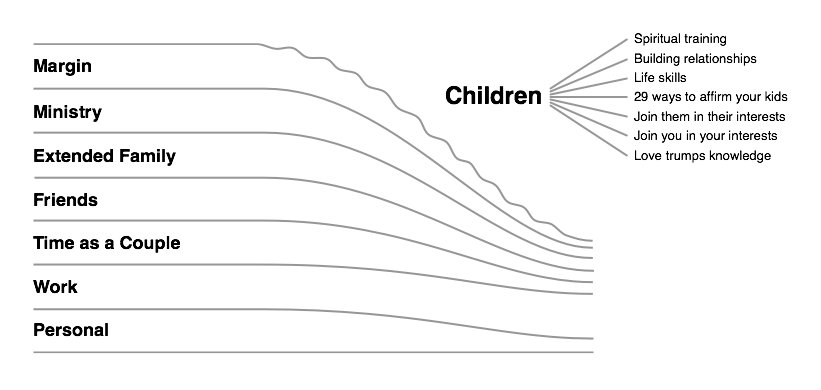
Last time, we introduced you to this diagram that provides the background for our “balancing family, work, and church” discussion.

children-drawing

The categories on the left represent life before kids.  We have our personal time; hobbies and other interests.  We have our work commitment, time as a couple, and spending time with friends.  Other categories are our extended family, ministry pursuits, and some time for margin in our lives.

What I tried to show in the drawing is how all those areas get squeezed when the kids come along.  One of the few exceptions is our work.  That time requirement generally stays the same after the children arrive and I showed that with the thickness of that category staying the same.  But what about the others?  We are just going to have less time in them.

For example, when I was in college I did a lot of reading.  When our family was growing, I probably did not read one book a year.  That is just a snapshot of how things naturally change when you are raising a family.  There will be less knitting, less fishing trips, fewer dates, and fewer outings with friends.  This change is not a bad thing, because someone new is in your life.  The key to health in these areas is that while they cannot stay the same, you do not want them to go to zero either.

Thinking about just one of these areas for example, if you let your time as a couple go to zero in those busy years with children, what will life look like when you come out the other side; when the children leave the house?  There will be no spark, no fire, no romance, and you will look at each other and wonder, “Who are you?”  No, we cannot let these areas go to zero.  So how do we balance the “they can’t stay the same” and “they can’t go to zero”?

We will talk about some practical ideas to do just that…next time.